
Master of the Ceremonial Space: What It Means To Stand In Your Own Authority
When someone is beginning their celebrant career, depending on their training and/or disposition, they might feel nervous, apprehensive and vulnerable. Perhaps they think everyone around them knows more than they do and so it’s possible that comments from others (such as wedding planners and funeral directors) might shape what they do or say.
For example, years ago one of our Heart-led Celebrants was told by a funeral director that she must say ‘ashes to ashes, dust to dust’ in her Interment of Ashes ceremonies. As she wasn’t taught this in her training, she came back to me for clarification. “There’s a reason you weren’t taught that,” I said, “and why we don’t include those words. They’re not from the Bible. They’re from the Book of Common Prayer (1549). The reason people use these words in ceremonies is because they’ve been made popular by TV.”
A Heart-led Celebrant must take a conscious approach to every word or phrase they use, and why they use them. ‘Dust to dust’ is rooted in the Biblical account of creation and sin, and because Adam was a ‘naughty boy’ he would return to dust (and so will the rest of us). Are we, as celebrants, promoting the concept of sin? Are we there as ministers of a faith that believe this to be true? On this note, I never understand why humanists would use this phrase.
In Christianity, ‘ashes’ wasn’t related to cremation at all but was recorded as text for a burial service. It has a completely different context than what we imagine when we are placing a loved one’s ‘ashes’ in the ground. (Note: they aren’t ashes, but cremated remains, known in the industry as ‘cremains’: they are pulverised bones).
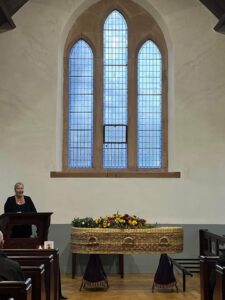
Veronika officiating at Ashgate Lane Cemetery Chapel
In my role as celebrant trainer, I’m quite clear that a (certified) Heart-led Celebrant is the master or mistress of the ceremonial space. Their role is to stand with confidence in their own authority. This means making decisions about the space if something isn’t right: lighting, noises, amplification, set up and so on.
One of the many reasons why a celebrant might not feel like the authority of the ceremonial space is because they don’t have legal ownership. That is, they don’t own a crematorium or a wedding venue. We come onto a premises that is someone else’s. Subconsciously, there may even be a feeling of ‘trespassing’. However, we are coming there for a purpose. To hold the space and create a ceremony for someone to receive. Therefore, in order for us to do our job with any level of excellence, there will be elements that need to be in place. If something isn’t right, it is up to us to do everything we can to sort any issues out.
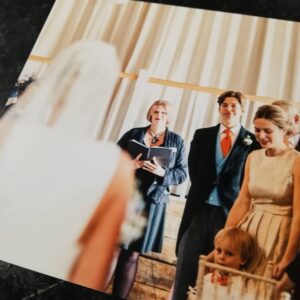
Veronika officiating Paul and Fiona’s ceremony at Askham Hall
Whether our sense of space comes from intuition or experience, what is important is that we find our voice and speak up if something isn’t right. There’ll be times where things are out of our control and there isn’t anything we can do about it, such as a Christmas tree right next to the lectern. When you’re officiating a suicide bereavement in the week before the ‘festive season’, there’s something about that tree that feels wrong on every level. Things you may be able to do something about include lighting (too bright, too dim), grubby windows in a wedding venue, the obtrusive registrar’s table in your ceremony space. You may be able to choose where a couple stands so that the ‘fire exit’ sign isn’t behind their heads in every ceremony photo. If there’s a communal handtying ritual, you can ensure that the photographer is one side and the wedding guests are celebrant side for the tying.
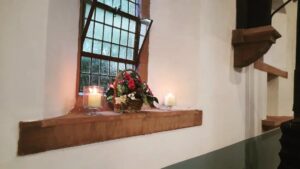
There are certain burial chapels that I work in, where I add to the ambience by lighting candles on the window ledges. While there is nothing in my job description that says I have to do that, I know it makes a huge difference to how it feels when mourners arrive.
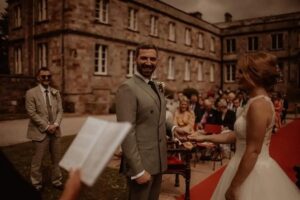
Veronika officiating Paul and Katy’s ceremony at Appleby Castle
The whole time, as master of the ceremonial space, we are looking, listening, sensing how the setting will impact the experience, whether that is yours or the guests (or both). Finding our voice as a celebrant, and taking ownership of the ceremony, is our work right.
Veronika Robinson and Paul Robinson are a husband and wife team whose boutique celebrant training Heart-led Celebrants attracts people from around the world. Heart-led Celebrants has earned a reputation for excellence in celebrant training, and those who are certified exemplify the highest standards in the industry. Veronika is the author of many books including the popular Celebrant Collection: Write That Eulogy; The Successful Celebrant; Funeral Celebrant Ceremony Planner; Wedding Celebrant Ceremony Planner; The Discrimination-free Celebrant; The Five Elements.
Award-winning voice artist, Paul Robinson, has had a whole career centred around his voice and other people’s. He’s highly experienced as a celebrant, trained actor, drama coach, voice-over artist, singer, broadcaster, compère, and ventriloquist. Paul is an excellent communicator and teacher, and has a sixth sense about how to relate to individuals, groups and audiences.

