Finding Your Centre as a Celebrant
A celebrant recently asked me a question along the lines of “How do you (as a celebrant) learn to create a ‘smooth’ performance?” The short answer is practise, practise, practise. The long(er) answer is below.
We were reflecting on what a ceremony of mine might look like (after thirty years in the job) compared to someone who, for example, was just starting out, or had only been officiating for a few years or maybe even if someone didn’t have great training.
In no particular order, my answer is:
The only thing we really have control over is how we respond to things/situations. This ‘response’ factor is where our power lies. Some call it ‘the swan’ (like my funeral director called me after we had a ridiculously stressful situation to deal with that would have left some celebrants and FDs gasping for air). Being able to stay calm in the face of disruption, difficulties and disasters is the key to professionalism. We are meant to be holding the space and leading people through a ceremony. Therefore, like a ship’s captain, we need to skilfully guide through the rocks and storms, as if the sea were as still as glass. A skilled celebrant will bring that calm as a matter of course regardless of external influences. Our energy is immediately picked up. For me, I don’t want my audiences to feel stressed, anxious or troubled. What I want is to create a space of calm, grace, levity and joy (if appropriate). Whatever the intentional mood, I want it founded on peace.

Stillness is a superpower. Like silence, this can become part of your life practice. Such inner resources will always stand you in good stead personally and professionally.
Developing smoothness means dissecting every ceremony (for years and years and years on end) and studying your performance forensically for mannerisms, speech patterns, eye contact, audience connection, migration and transition between content and sections of a script. We should never stop learning or seeking excellence.
The thing about asking for external feedback (from friends, family, even funeral directors or wedding planners) is that they won’t necessarily know what to look for. People see what they want to see and hear what they want to hear. If they’re used to your voice, for example, they may not notice mannerisms, tone, depth, quality, volume and timbre. YOU need to become the expert of looking for and hearing what works and what doesn’t work, and then seek to improve any issues or obstacles to a smooth presentation.
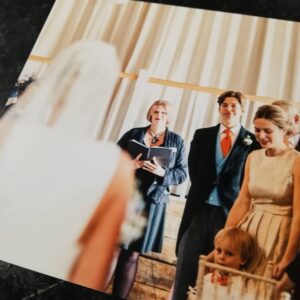
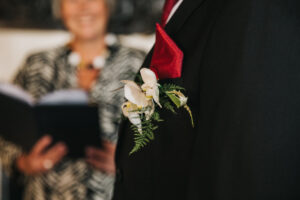
Officiating at Askham Hall for Fiona and Paul
A huge (vital) part of creating a seamless presentation is (obviously) presence, but also preparation. Preparation comes down to rehearse, rehearse, rehearse. I go through each of my scripts about twenty times so that it feels like a second skin on the day of the ceremony. I’ve heard celebrants say that they want it to feel ‘fresh’ so they don’t rehearse. Some don’t even read a script out loud once. To my mind, freshness comes from familiarity and having learned with each rehearsal the varied landscape of the script. A professional can do this with ease. If you can’t find something new to explore and experiment with each time you go through your script, maybe it’s time to go back to the drawing board and refresh your writing skills. If you’re not excited, enlivened, moved or reflective with your script, this will pass to your listeners.
Presence is an interesting topic. I believe we either carry magnetism with us or is something that we have switched off at some point in our life (for whatever reason). With presence, we are authentically ‘present’ throughout the ceremony. Presence, or magnetism, isn’t about being all ‘jazz hands’ and thinking we are at our latest Am Dram performance. Presence is about truth. When you are connected to your script, to your clients, to the ceremonial space, and to your heart, then you have presence. A key factor, I feel, is that rather than projecting or ‘pushing’ your words out to the audience, let them lean into your energy, to your presence, to your being. That is, energetically invite them in rather than push them away. This is quite a subtle thing but when you get it, it’s a gamechanger.
Nerves and anxiety are often stumbling blocks for celebrants. There are ways around these (despite your disposition) and it really comes back to being present.

The quickest way to calm your nervous system is by letting yourself know that YOU ARE SAFE. Put yourself into a position where this feels true for you. I mentioned earlier about choosing how you react to things. You can change the way your body is feeling in four super-quick and effective steps. Once you learn how to self-regulate, you’ll approach your ceremonies (and life!) in a completely different way.
• Anchor yourself. Feel your feet below you. Imagine yourself fully connected to the ground or floor beneath you. This will be a lot easier if you’re not wearing heels! If it helps, imagine your feet are growing roots deep into the earth.
• Look around the ceremonial space and take your time doing this. This ‘slow survey’ will allow you to settle in and have a sense of ownership of the place.
• Touch something. If you’re in a crematorium or wedding chapel with a lectern, touch it. Use both hands if necessary. Again, this will orientate you to the space. If there’s really nothing you can touch, like a table, push your thumbs into each finger starting with the small fingers. With each finger, you can say a word (in your mind) like I AM CALM NOW. This can be such a powerful habit that you can use each time you’re about to start a ceremony (or in any situation where you need to settle down).
• Contrary to popular opinion, don’t take a big, deep breath in. Rather, let a short breath slip into your body, then release it slowly and deliberately with a nice long out breath. Do this for as long as you can before the ceremony starts or while a piece of music is playing or someone’s doing a reading.

Outside of ceremony time, why not create a breathwork and grounding practice so you can develop these skills? By doing so, you’ll be able to naturally induce a state of calm at will. Public speaking doesn’t have to equate with nerves and anxiety. You have a choice.
Finally, to become world class in anything, it takes about 10 000 hours of ‘intelligent’ practise. The key to the intelligent reference, is that in celebrancy, that practise needs to be based on excellent habits and awareness.
May you find your centre, and enjoy presenting ceremonies that are smooth as silk. Or a baby’s bottom. Maybe a dew drop? A river-tumbled pebble? Or my satin pillowcase. Definitely my pillowcase! 
Veronika Robinson and Paul Robinson are a husband and wife team whose boutique celebrant training Heart-led Celebrants attracts people from around the world. Heart-led Celebrants has earned a reputation for excellence in celebrant training, and those who are certified exemplify the highest standards in the industry.
Veronika is the author of many books including the popular Celebrant Collection: Write That Eulogy; The Successful Celebrant; Funeral Celebrant Ceremony Planner; Wedding Celebrant Ceremony Planner; The Discrimination-free Celebrant; The Five Elements.
Award-winning voice artist, Paul Robinson, has had a whole career centred around his voice and other people’s. He’s highly experienced as a celebrant, trained actor, drama coach, voice-over artist, singer, broadcaster, compère, and ventriloquist. Paul is an excellent communicator and teacher, and has a sixth sense about how to relate to individuals, groups and audiences.